High-integrity isolation valves built to withstand high atmospheric salinity, severe soil stress, and high-pressure transmission dynamics.
Benin is rapidly transforming into a major logistical hub and energy transit corridor for the West African sub-region. Under the impetus of regional integration projects, such as the West African Gas Pipeline (WAGP) and the crucial Niger-Benin Crude Oil Export Pipeline, the country is witnessing unprecedented demands for robust midstream infrastructure. Heavy-duty fluid control products are central to maintaining the safety and environmental integrity of these high-pressure transit lines.
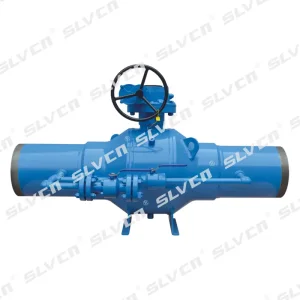
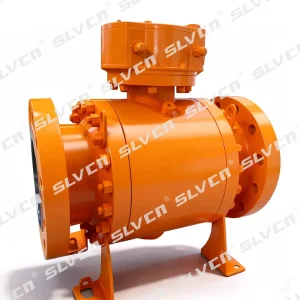
At the Port of Cotonou, extensive modernization has driven the construction of major hydrocarbon storage depots, bunkering terminals, and regasification infrastructure. These coastal processing plants operate in high-humidity, marine-saline environments where external corrosion represents a major operational hazard. Under these harsh parameters, traditional bolted-bonnet valves present high risks of fugutive emissions and external seal degradation. Fully welded ball valves—featuring body designs that eliminate potential leak pathways across the shell—have emerged as the engineering standard for modern Benin engineering teams.
Furthermore, inland municipal grid distribution and electricity plants (such as the Maria-Gléta Power Plant expansion) require seamless and uninterrupted fuel delivery. Fully welded valves, manufactured to API 6D specifications, ensure that high-velocity natural gas is delivered safely, minimizing line losses and matching strict environmental standards.
Why structural zero-leakage, forged bodies, and double block & bleed (DBB) capabilities are critical for critical pipeline isolation.
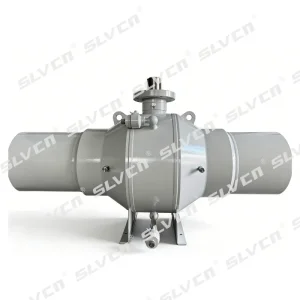
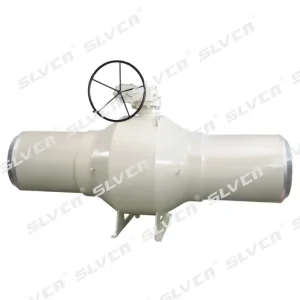
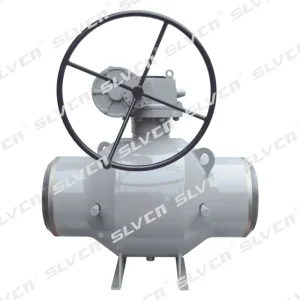
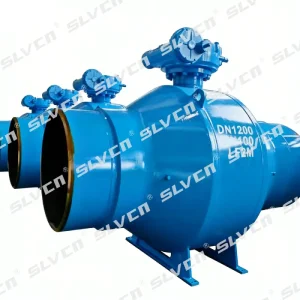
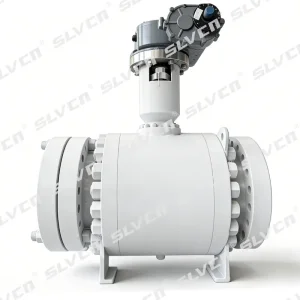
By eliminating structural flanges, gasket joints, and bolting, the fully welded body forms a unified pressure vessel. This structure completely prevents fugitive emissions, complying with ISO 15848-1 tightness Class A.
Utilizing high-grade ASTM A105, A350 LF2, or F316 forged materials. Forging guarantees uniform grain flow, zero internal casting defects (like porosity or inclusions), and excellent toughness under pressure spikes.
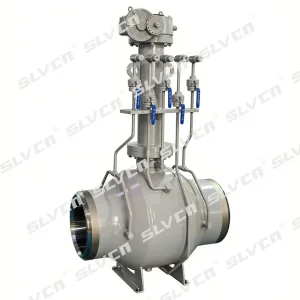
Engineered with self-relieving or double piston effect (DPE) seats. The DBB mechanism allows operators to block both upstream and downstream lines and bleed the body cavity, ensuring absolute safety during maintenance.
In geotechnical environments like Southern Benin, clay-heavy soils undergo significant volumetric expansion and contraction during alternate wet and dry seasons. This movement applies massive bending stresses (bending moments) on buried gas lines. Cast valves exhibit relatively low tensile strength, which under external bending loads can lead to stress cracking at the joint flanges.
Forged fully welded ball valves match the elastic modulus of the pipeline itself. Once welded directly to the line pipes (with transition pup pieces), the valve becomes an integral part of the continuous conduit. Stresses are distributed uniformly through the steel wall, eliminating localized fatigue points.
Explore our industry-certified products designed for high-stress natural gas networks and cryogenic liquid storage facilities.
Technical capabilities, metallurgical validation, and high-performance quality testing procedures.
Chinese valve factories have transitioned from basic manufacturing to high-end engineering hubs. By utilizing advanced CNC multi-axis machines and automated welding stations (specifically SAW and robotic GTAW), factories achieve precise control over weld line integrity, weld depth, and HAZ (Heat Affected Zone) metallurgical parameters.
For projects in Benin, choosing a leading Chinese OEM manufacturer guarantees API 6D compliance, API 607 Fire-Safe certification, and strict adherence to international QA protocols. Advanced in-house testing equipment allows for regular non-destructive testing (NDT), including Ultrasonic Testing (UT), Magnetic Particle Testing (MT), and Radiographic Testing (RT) of raw forgings and pressure welds.
Through centralized steel purchasing and high-capacity manufacturing, Chinese manufacturers provide cost-efficiencies that lower Capex for projects in Benin. Backed by extensive logistics channels, factories can coordinate secure shipping directly from Shanghai or Ningbo to the Port of Cotonou, offering comprehensive tracking and packaging (such as export-grade seaworthy wooden cases protected by VCI vapor corrosion inhibitors).
With over 30 years of expertise in forging high-performance ball valves, SLVCN provides project-ready solutions for demanding industrial environments. Our products are engineered, tested, and certified to meet the strictest international standards, ensuring zero-leakage and reliable operation.
We deliver the safety and precision required for challenging pipelines, marine storage depots, and power generation networks. Trusted by engineering companies globally, SLVCN offers reliable fluid control solutions built for long-term performance.
Inquire Online NowAdapting pipeline flow control products to the unique challenges of regional operating environments.
Integrating fully welded valves lowers long-term operational costs by eliminating regular gasket maintenance and potential fugitive emission line-stoppages, ensuring efficient operations.
We supply complete actuator adaptation packages (pneumatic, gas-over-oil, electric) with emergency manual overrides, allowing operators to secure lines in case of emergencies.
Corrosion protection using high-build solvent-free polyurethane or epoxy materials. These coatings provide resistance to cathodic disbondment and mechanical impact during backfilling.
Real-world applications proving the reliability of our products under demanding service conditions.
Project Scope: Upgrading manual gate valves on primary receiving manifolds to high-integrity automated isolation ball valves.
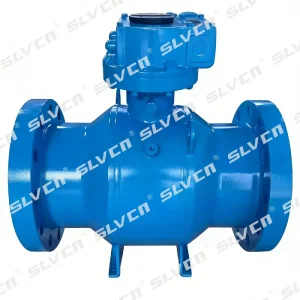
Solution Implemented: SLVCN supplied 12" Class 300 RF Forged DBB Trunnion Ball Valves equipped with heavy-duty electric actuators. The double block and bleed system allowed verification of zero leakage, minimizing risks during tanker offloading.
Project Scope: Constructing lateral gas distribution pipelines to local industrial zones requiring buried valves with extended stems.
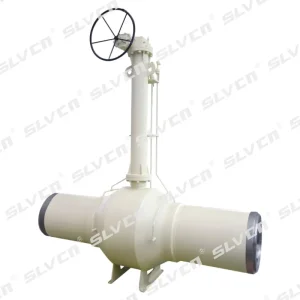
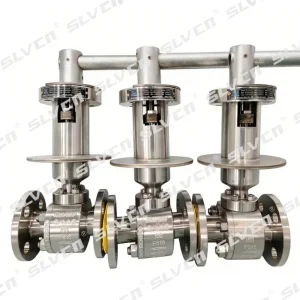
Solution Implemented: Fully welded trunnion ball valves with 3-meter extended stems and heavy polyurethane external coatings. The transition pup pieces were pre-welded under cleanroom factory conditions to simplify on-site installation.
Technical answers to key procurement and engineering questions regarding pipeline ball valves.
Contact our technical engineering team for valve designs, dimensional drawings, material certifications (MTRs), and pricing tailored for Benin and West African energy infrastructure projects.
 Shoulong Valve